
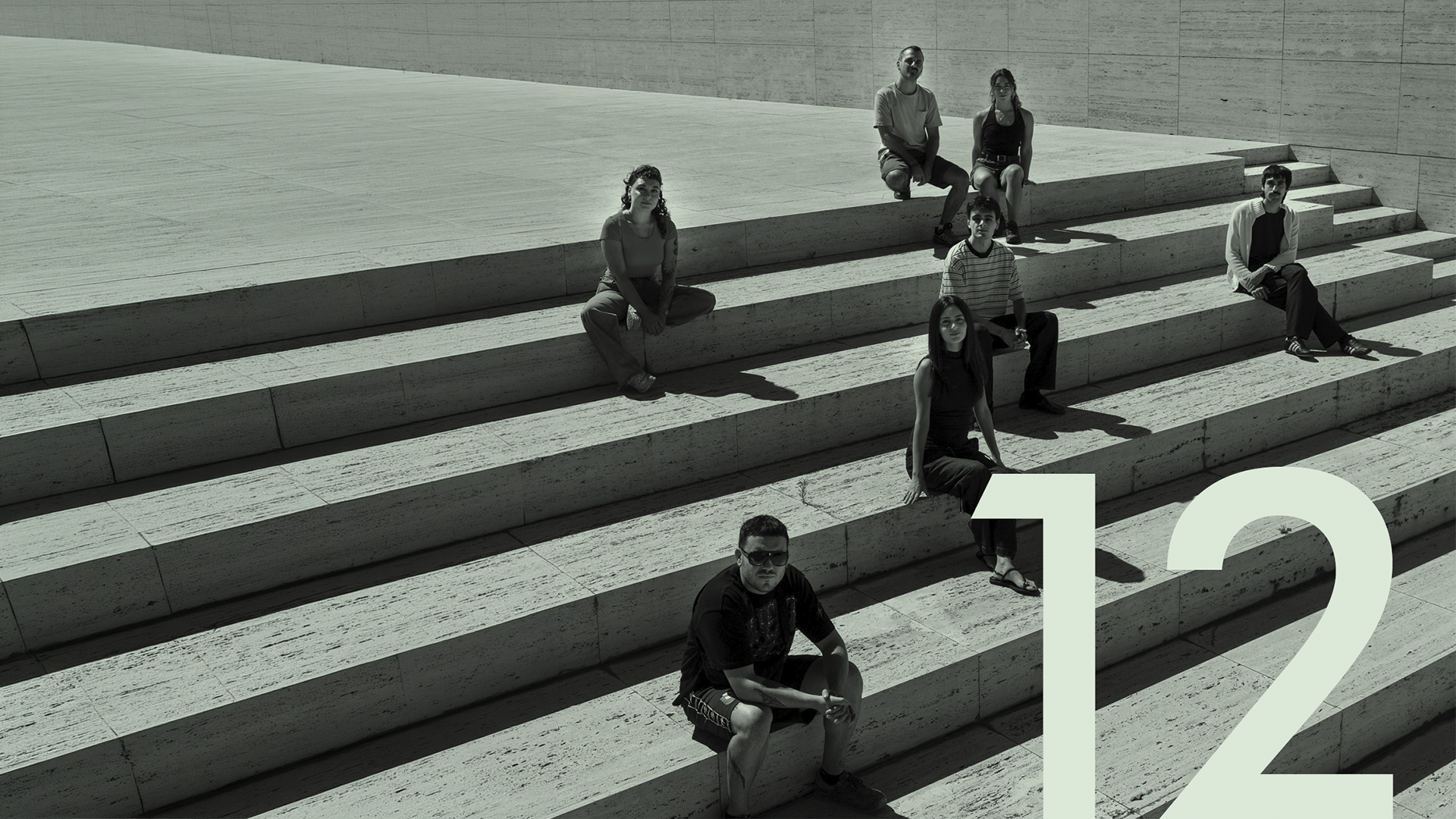
Since its foundation, the University of Alicante Museum (MUA) has remained steadfastly committed to contemporary art. This led to the launch of its Residency Programme for Artistic Creation and Research in 2015, a public initiative aimed at promoting creation and research in the visual arts and galvanising the contemporary art sector.
Under this programme, five artistic projects are selected to be undertaken within the MUA facilities for a two-week period. The resident artists, who are awarded a grant covering production and travel expenses, get a chance to be with other artists, work at our institution, become familiar with its dynamics and receive guidance from our technical staff while giving shape to their projects.
The 12th Residency Programme has taken place between 14 and 25 September 2026, further cementing the UA Museum’s position as a meeting point for practitioners and researchers in contemporary art. The five selected projects are Entrar en contacto, by Ruth Cuadrado; Territorios blandos, by the GAR team (its members are Raúl Terol and Alba San Jaime); En negativo (53), by Marc Mateos Monteagudo and Candela Carrillo Santos; Obertura de si, by Jaume Mello; and Tectónicas de cuerpos, by Pablo Quesada. For two weeks, the seven artists have shared experiences and work processes, intent on completing the projects presented today in the UA Museum’s Sempere Hall.
Enjoy this exhibition and explore the creative universes of these contemporary artists.
Entrar en contacto
Ruth Cuadrado
Inhabiting a space goes beyond merely occupying it: we must engage with the world around us and let ourselves be influenced by its dimensions and limits, the paths it opens up, its material conditions. From this perspective, our body and the surrounding space are not two separate entities, as the former takes part in the relationships established by said space, orienting itself, moving closer and further away from people and things, changing through experience. As pointed out by Sara Ahmed, “[b]odies are hence shaped by contact with objects and with others.”
This leads to the question posed by Entrar en contacto: what happens when we view space as something that reaches out to touch us? From this point onwards, our sense of touch – in theory, nothing more than an experience linked to the surface of an object – turns into a form of relating to and affecting others. Karen Barad argues that touching is never a neutral act, that every contact involves a transformation and creates a “gap” between toucher and touched that makes contact possible.
The artist’s research examines that gap between the body and its surroundings, the space where contact is never static and every relationship leaves a mark. The installation is conceived as an intermediate space, an active void in which the boundaries between touch, body and matter become blurred and the spatial experience evolves into a form of knowledge.
Territorios blandos
GAR team. Raúl Terol / Alba San Jaime
Raúl Terol and Alba San Jaime employ humour to build an interdisciplinary universe whose characters are works of art – and they know it. Fiction allows the team to reflect on the role of artists and the very concept of art, generating situations in which they make it deliberately impossible to tell reality from representation.
The project provides an in-depth look into the residency programme and its participants. Drawing on the experiences, debates and concerns shared over these weeks, the artists create a series of characters that collectively represent the contemporary art scene and the relationships occurring within it.
Originally modelled in plasticine (associated with notions of transformation and change), the characters were subsequently “reborn” in various formats. What is represented changes with every rebirth, giving rise to a meta-residency: an account of the experiences the artists went through that reproduces the exhibition hall at scale. The installation thus offers an experience at once familiar and novel in which resident artists and visitors can recognise themselves, even if only partially.
En negativo (53)
Marc Mateos Monteagudo / Candela Carrillo Santos.
En negativo (53) is an exploration of images as active spaces of contact, transformation and conflict. Through painting and sculpture, the artists investigate the processes whereby images nowadays accumulate and deteriorate over time.
The project brings together two strands of research that question the fixed nature of images. In Carrillo Santos’ work, images operate as skins: a permeable surface that receives and sends back the narratives going through it. She is particularly interested in the poetics of infrathin grammars, in those contents that may eventually disappear.
Mateos Monteagudo does not see figurativeness as an immutable record either. Images appear as the remains of something else, in constant transformation: they continue to exist because they are always changing. That which ensures their legibility also becomes the place from which they can take a different shape.
En negativo (53) alludes to this tension, questioning what defines an image as a presence, a record or a representation. In other words, the project sheds light on the fragility of systems designed for storing, classifying and describing visual material.
Obertura de si
Jaume Mello
Obertura de si is a creative and research project undertaken within the UA Museum’s 12th Residency Programme. The artist investigates as he drifts and wanders around, taking a close look at his surroundings to search for things that are there, but can go unnoticed.
During the process, he records and gathers elements found near his workspace; this is followed by a stage of formal and compositional experimentation. Assemblage gives him the chance to reshape the world around him and discover new relationships between its fragments. He creates negatives to highlight that which is present in the surrounding space, yet we are unable to perceive immediately.
Jaume Mello analyses how we can use our imagination to go beyond the given reality and interpret our surroundings in a different way. Assemblage gives new meanings to an object outside its original context; likewise, imagination alters our perception of an apparently immutable environment. In Obertura de si, assemblage techniques allow us to imagine unexpected possibilities.
Tectónicas de cuerpos
Pablo Quesada
Pablo Quesada reverses the material hierarchies present in everyday objects, questioning why strength should be considered superior to fragility. Paper or fabric, generally regarded as secondary or two-dimensional supports, here become structural materials that hold in place, tighten and articulate metal bodies, pushing the conventional boundaries between support and object.
Conducted during the UA Museum’s Residency Programme, this research focuses on spatial tensions generated by the way industrial and everyday connections have changed. Painting and drawing are incorporated into the structures to keep a record of the construction process, ensuring the continuity between plane and volume and highlighting the process whereby matter is transformed.
Natural light is another key structural element in this installation, as it can subtly alter shadows and change the relationships between various components. As a whole, the project explores the function, strength and physical behaviour of materials when altered by artistic gestures.