
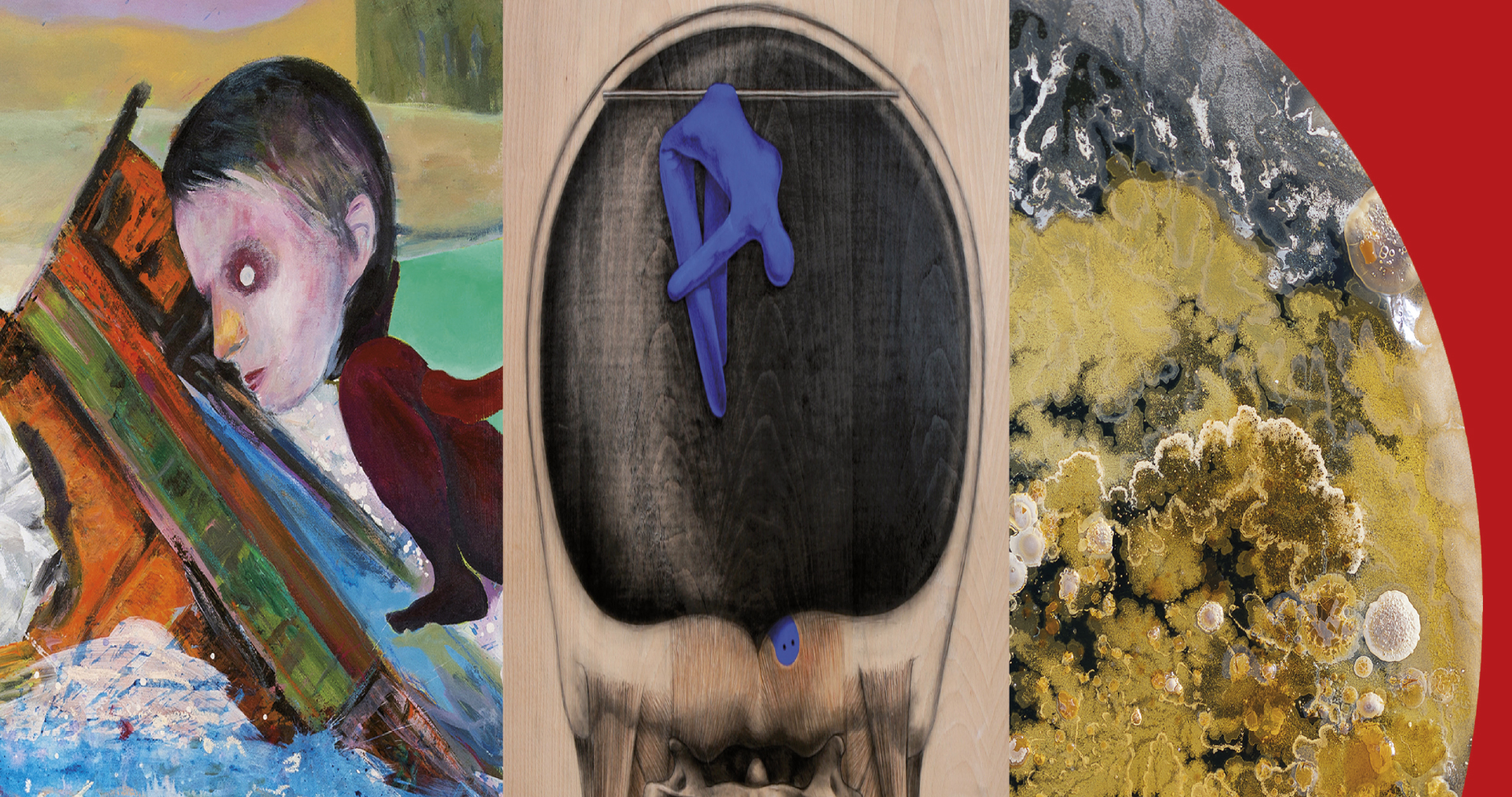
It is always a good time for art – that’s the idea that the exhibition title, which translates as “Art time”, intends to convey. The University of Alicante’s Antoni Miró Research Chair in Contemporary Art, with support from Alcoi City Council, launched a new edition of its contest and funding programme for artists in June 2025. Under the programme, three grants were awarded with the aim of staging exhibitions of contemporary art. The selected candidates were Xavier Colomer, Rafael Hernández and Anna Pastor, who – in accordance with the relevant call for applications – showed their works at Alcoi’s Llotja de Sant Jordi centre between February and March 2026, as part of a series of exhibitions and other activities organised by the Antoni Miró Research Chair and Alcoi City Council to promote the visual arts. Furthermore, some of their pieces will be displayed in the University of Alicante Museum’s Cub2 hall from 17 September to 13 December 2026.
The exhibited works all revolve around the topics of visual loss, the inability to take an in-depth look at things, and physical and metaphorical invisibility.
Javier Colomer’s series, entitled “Encegats” [“Blinded”], combines colour, light and shadow to represent an allegorical blindness stemming from visual saturation, as nowadays we are overwhelmed by a constant stream of images that is hardly compatible with insight and contemplation. “Encegats” can be described as the artist’s emotional response to the impossibility of looking at things critically and thoroughly.
“El pintor cec” [“The blind painter”], by Rafael Hernández, is concerned with visual dysfunction, hence the references to Braille and the blue tones found in most of his pieces. The artist also highlights contemporary aspects such as our (figurative) blindness when confronted with the dire consequences of technology-driven social change, algorithms and artificial intelligence: climate change, wars and many other examples of human stupidity, recklessness and cruelty.
Finally, in the series “Tots els cossos que som” [“All the bodies we are”], Anna Pastor focuses on things that, while invisible to the naked eye, can be perceived through art, science and relational thinking. Pastor uses cultures in Petri dishes, enlarged photographs and ceramic pieces to remind us that our body also contains millions of microorganisms that influence our physical, mental and emotional health.
In Fabuel’s words, “it is an artist’s duty to make the invisible visible”. That’s the purpose of this exhibition: to draw upon all these references, situations and emotions in order to enhance sensory perception, analyse a multifaceted reality and encourage self-knowledge.